EdgeIO Edge Controller BL192Pro Empowers Traditional Dyeing Factories: The IT/OT Convergence Journey from "Experience-Based Dyeing" to "Data-Driven Dyeing"
Case Details
EdgeIO Edge Controller BL192Pro Empowers Traditional Dyeing Factories: The IT/OT Convergence Journey from "Experience-Based Dyeing" to "Data-Driven Dyeing"
1. The Efficiency Dilemma of Traditional Dyeing Factories
Dyeing is the most technically demanding, energy-intensive, and quality-fluctuating link in the textile industry chain. Walking into a traditional dyeing factory, you might see scenes like these:
Beside the dyeing machines, veteran operators stare at the pointers of thermometers and manually adjust steam valves based on experience; the process sheet reads "heating rate 1.5°C/min", but actual execution relies entirely on manual judgment; when a batch of fabric comes out with the wrong shade, it has to be reworked or even scrapped, yet the cause remains unclear; energy consumption reports arrive only at month-end, showing only total electricity and steam usage, without revealing how much each dyeing machine actually consumed.
Behind these dilemmas lie three core pain points:
First, temperature control relies on "feel". Dyeing processes are extremely sensitive to temperature – a deviation of 1°C/min in heating rate or 2°C in holding temperature can cause colour differences. Traditional dyeing machines mostly use simple temperature controllers with fixed PID parameters that cannot be dynamically adjusted according to process stages.
Second, equipment are "information silos". Dyeing machines, stenter frames, dryers come from different manufacturers with varying communication protocols. Production data remain local to the equipment; management cannot see real-time production progress, and process engineers cannot access actual process curves.
Third, IT and OT are disjointed. Equipment-level OT data cannot flow smoothly to the management-level IT systems (ERP, MES). Energy analysis, quality traceability, and process optimisation all lack data support.
Bari Technology's EdgeIO Edge Controller BL192Pro offers a low-cost, deployable new path for the digital transformation of traditional dyeing factories – one device replaces the cumbersome combination of "PLC + I/O modules + protocol conversion gateway + cloud gateway" , shifting dyeing from "experience-driven" to "data-driven".
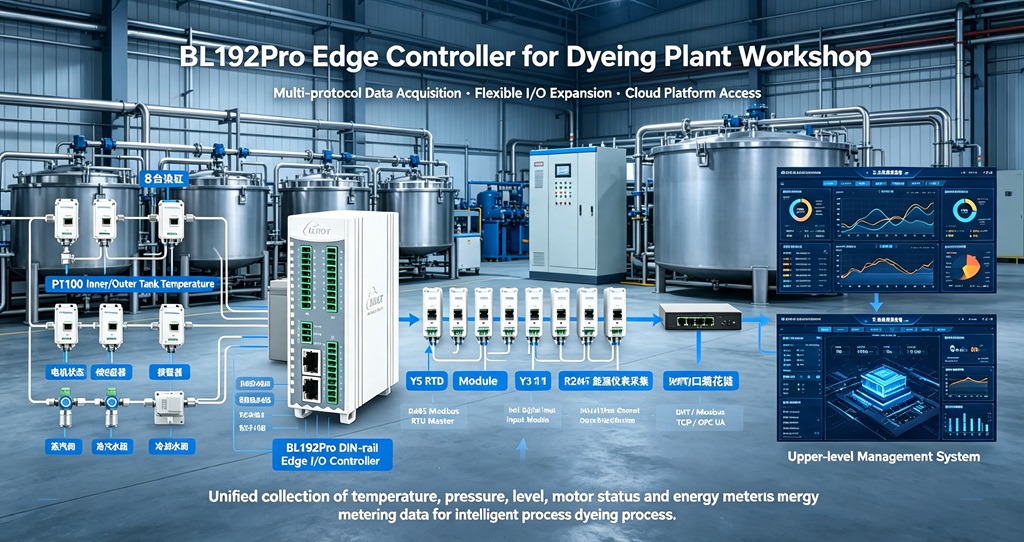
2. Hardware Deployment of BL192Pro in the Dyeing Workshop
The BL192Pro is a DIN-rail-mounted multi-protocol edge I/O controller, specifically designed for industrial IoT and smart manufacturing. It supports a wide operating temperature range (-40°C to 85°C), has passed EMC/EMI tests, and incorporates a hardware watchdog. It features dual RJ45 Ethernet ports (with an integrated switch) and one isolated RS485 port, natively supporting MQTT, Modbus TCP, and OPC UA as three uplink protocols, enabling direct connection to industrial cloud platforms and upper-layer management systems.
The BL192Pro offers 1~3 Y‑series I/O expansion slots, allowing flexible combination of over 20 daughter-board types (digital, analogue, temperature, serial, pulse, etc.) according to on‑site signal requirements.
Taking a typical dyeing workshop as an example – 8 dyeing machines need retrofitting, and each machine requires the following signals:
Each dyeing machine is equipped with one BL192Pro plus the corresponding I/O daughter boards; the total width is less than 60 mm, and they snap directly onto the DIN rail inside the machine's electrical cabinet. If a machine later requires pH monitoring, you simply replace the corresponding I/O module – no need to replace the whole unit or re‑wire.
The BL192Pro's RS485 port acts as a Modbus RTU master, supporting up to 25 commands, and can simultaneously collect data from energy instruments (smart power meters, steam flowmeters, water meters) associated with the dyeing machines. The dual Ethernet ports support daisy‑chain cascading – the BL192Pros of 8 dyeing machines are connected in series, and the entire chain occupies only one port on the workshop switch, significantly saving cabling and switch costs.
3. Logic Control Principles: Making the Dyeing Process "Precise to Every 1°C"
The BL192Pro has built‑in edge computing capabilities and local logic control functions, capable of operating independently even when the network is down. Through its built‑in Web interface, engineers can perform register operations, conditional judgments, PID tuning, and other logic programming without learning PLC ladder logic or ST language.
3.1 Temperature PID Control – The Core of Dyeing Processes
Temperature control in dyeing consists of three phases: heating, holding, and cooling. The BL192Pro reads the in‑machine temperature in real time via the PT100 module and executes the following control logic:
Heating phase: The system calculates the deviation between current temperature and setpoint, computes the steam valve opening command via a PID algorithm, and outputs the control signal through the relay module (or analogue output module for proportional valves). The heating rate strictly follows the process curve – for example, "from room temperature to 98°C at 1.2°C/min" – and PID parameters can be dynamically switched according to different process stages.
Holding phase: The temperature is maintained at 98°C ± 0.5°C. The PID algorithm switches to high‑precision mode, frequently fine‑tuning the valve opening to ensure temperature fluctuations remain within tolerance.
Cooling phase: The steam valve is closed and the cooling water valve is opened, with the cooling rate controlled to prevent rapid fabric shrinkage.
The BL192Pro supports multiple preset PID parameter sets – different fabric types and dyes can call different PID parameter groups without re‑tuning each time. All temperature data are recorded in real time, forming complete process curves for subsequent quality traceability and process optimisation.
3.2 Sequence Control – Automating Dyeing Steps
Dyeing is a typical sequential process: fabric loading → water filling → dye/auxiliary addition → heating dyeing → holding → cooling → draining → washing → unloading.
The BL192Pro acquires status signals for each step (level reached, door closed, motor running, etc.) via its DI modules, and triggers the next action in sequence through DO/relay modules. For example:
-
Level sensor (AI) detects water level reaches setpoint → trigger chemical feed signal (DO)
-
Chemical feed complete (DI detects feed pump stopped) → start heating program (PID control)
-
Holding time expires → close steam valve, open cooling valve
-
Temperature drops to setpoint → open drain valve
The entire process requires no manual intervention – process parameters are configured in the Web interface, and modifying a process curve only requires adjusting a few values in the browser.
3.3 Interlock Protection – Dual Assurance of Safety and Quality
The BL192Pro simultaneously executes multiple interlock protection logics:
-
Over‑temperature protection: if temperature exceeds a safety threshold (e.g., 105°C), immediately cut off the steam valve and trigger audible/visual alarm
-
Low‑level protection: if liquid level falls below the heating tube exposure height, automatically stop heating to prevent dry‑heating
-
Door interlock: prevent starting any running program if the dyeing machine door is not properly closed
-
Motor overload protection: DI detects motor thermal relay trip → immediately stop and alarm
All these logic executions happen locally on the BL192Pro with millisecond‑level response times, independent of the network.
4. IT/OT Convergence: Bringing Data from the Workshop to the Office
The biggest problem in traditional dyeing factories is that "data cannot get out" – OT data at the equipment layer are trapped in the workshop, while management‑level IT systems (ERP, MES, energy management platforms) cannot obtain real‑time data.
The BL192Pro natively supports MQTT, Modbus TCP, and OPC UA simultaneously. One device plays three roles at once:
4.1 Data Collector (OT Layer)
Through Y‑series I/O modules, it collects temperature, level, pressure, and operating status from dyeing machines; through RS485 (Modbus RTU master), it collects energy data from smart power meters, steam flowmeters, and water meters.
4.2 Protocol Converter (Bridge between OT and IT)
-
Via the OPC UA server, it exposes data to upper‑layer management software – the MES system can read each dyeing machine's temperature curves and energy consumption in real time
-
Via MQTT, it uploads data to cloud platforms (Alibaba Cloud, Huawei Cloud, AWS IoT, ThingsBoard, etc.) – managers can view the entire workshop's production status from their office or even mobile phones
-
Via Modbus TCP, it interfaces with existing SCADA systems
4.3 Local Controller (Edge Computing)
All control logic is executed locally; even if the network fails, the dyeing machines continue automatic operation according to the set process curves. After network recovery, data accumulated during the disconnection are automatically backfilled.
5. Visual Data Management: From "Blind Operation" to "Transparent Production"
With the data acquisition and upload capabilities of the BL192Pro, dyeing factories can establish a complete visual data management system:
Real‑time monitoring dashboard: A workshop display screen or management backend shows, in real time, each dyeing machine's current temperature, process phase, remaining time, and energy data. Managers get an instant overview of the entire workshop's production status.
Process curve traceability: The complete temperature curve for each batch of fabric is automatically recorded and stored. When colour deviations occur, you can replay the entire process of that batch to quickly pinpoint whether the issue was due to excessive heating rate, unstable holding, or improper cooling.
Fine‑grained energy management: Using the electricity, steam, and water data collected via Modbus, energy consumption is tallied by batch, by fabric type, and by shift. If a batch shows abnormally high energy usage, the cause can be immediately investigated.
Remote operation & maintenance: Integrated BLRAT remote tool supports remote firmware upgrades, parameter changes, and fault diagnosis. Process engineers can modify a PID parameter from their office and push it simultaneously to all dyeing machines in the workshop – no need to visit each machine on‑site.
6. Benefits Analysis
Taking a medium‑sized dyeing factory with 20 dyeing machines as an example, after retrofitting with the BL192Pro:
Industry practice shows that similar dyeing/finishing digital retrofits can achieve a first‑pass accuracy rate of over 98% and reduce average energy consumption by 25%.
7. Conclusion
The BL192Pro edge controller offers traditional dyeing factories a low‑cost, deployable, quick‑payoff digital transformation path:
-
Hardware: modular I/O design configurable on demand, DIN‑rail mounting without production shutdown
-
Control: built‑in Web programming + PID algorithms, turning temperature control from "feel" to "precise to every 1°C"
-
Data: native support for MQTT, Modbus TCP, and OPC UA – three protocols that bridge OT and IT, enabling real‑time data flow from the workshop to MES, ERP, and cloud platforms
-
Management: visual dashboards + process traceability + energy analysis, turning production from "blind" to "transparent"
-
O&M: BLRAT remote tools enable remote upgrades, debugging, and troubleshooting, reducing on‑site interventions by 80%
From "experience‑based dyeing" to "data‑driven dyeing" – the BL192Pro changes not just the control method, but the entire production organisation and management philosophy of the dyeing factory.
Keywords: EdgeIO Edge Controller | BL192Pro | Dyeing Factory Automation | Textile Dyeing & Finishing | IT/OT Convergence | PID Temperature Control | Visual Data Management | MQTT Cloud Platform | Modbus Acquisition | OPC UA | Remote O&M | BLRAT | Edge Computing


