Physical AI refers to a new intelligent technology paradigm in which artificial intelligence models are deployed on edge devices in the physical world, enabling machines not only to analyse data and make decisions, but also to autonomously perceive environmental changes, understand complex operating conditions, and execute real-time physical adjustments.
Case Details
Physical AI-Driven Process Control Innovation: An AI+IT+OT Deeply Integrated Application Case Based on EdgePLC BL245 Industrial AI Edge Controller
1. What Is Physical AI and Its Industrial Value
Definition of Physical AI
Physical AI refers to a new intelligent technology paradigm in which artificial intelligence models are deployed on edge devices in the physical world, enabling machines not only to analyse data and make decisions, but also to autonomously perceive environmental changes, understand complex operating conditions, and execute real-time physical adjustments. The fundamental difference from traditional AI lies in:
-
Traditional AI: runs on cloud or server platforms, outputs analysis results or recommendations, and operates independently from physical execution systems (such as PLCs and actuators), leading to uncontrollable latency and a disconnect between decision-making and execution.
-
Physical AI: runs at the industrial edge, where AI inference results directly drive control logic, forming a complete closed loop from environmental perception → intelligent decision-making → physical execution – an autonomous agent that integrates “sense–think–act”.
The International Society of Automation (ISA) defines Physical AI as “a technical system that deploys AI models at the edge of physical systems to achieve autonomous perception, understanding, decision-making, and action.” In a 2026 joint white paper, Emerson and SiMa.ai further stated: “When operations teams leverage Physical AI at the edge, they move beyond simple monitoring into a new phase of closed-loop autonomous control – enabling real‑time process adjustments early in production to minimise product defects, reduce waste, and improve efficiency.”
Core Value of Physical AI in Industrial Process Control
In process industries such as chemicals, pharmaceuticals, oil & gas, and metallurgy, Physical AI delivers three paradigm‑shifting leaps in value:
① From “reactive response” to “predictive proactivity”
Traditional control systems only trigger alarms or shutdowns after parameters exceed limits. Physical AI, through time‑series prediction models, forecasts process deviations tens of minutes in advance, allowing ample time for proactive intervention and optimisation – turning “fire‑fighting after the event” into “prevention before the event”.
② From “relying on human expertise” to “data‑driven intelligence”
Experienced operators are a scarce resource in process industries. Physical AI transforms the tacit knowledge of the best operators into reusable AI models, enabling knowledge distillation and scalable replication, significantly reducing dependence on individual experience.
③ From “separated control and computing” to “unified control‑compute”
In traditional architectures, PLCs handle logic control while industrial PCs or cloud platforms manage data analysis – two separate systems with incompatible data and standards. Physical AI integrates real‑time control and AI inference on a single edge controller, so that AI results reach actuators directly, achieving millisecond‑level closed‑loop response and breaking through system integration bottlenecks.
2. Application Background and Challenges
A large fine chemical enterprise faced the following structural challenges on its polymerisation reaction line:
-
Control standards not adapted to the inherent complexity of process industries: Traditional PLCs work on a cyclic scan model, repeatedly executing “read inputs → execute program → update outputs” in fixed cycles. When dealing with multi‑reactor coordination or flexible batch production reconfiguration, programming becomes complex and reusability is poor.
-
“Control” and “intelligence” operate in silos: The conventional approach uses PLCs for logic control and separate industrial PCs or servers for AI analysis. The two systems run independently, leading to data disconnection, sluggish response, and difficult maintenance.
-
Lack of Physical AI capability: Advanced AI algorithms are often deployed in the cloud, with uncontrollable network latency to the field control system and data security risks, preventing true autonomous physical control.
-
Long deployment cycles for advanced control algorithms: Algorithms such as Model Predictive Control (MPC) typically run on dedicated servers and interface with underlying PLCs in a complex manner, often taking months to implement.
The essence of this dilemma is that traditional control architectures lack deep integration of AI, IT, and OT – the system has “execution” capability, but lacks “perception” and “thinking”, let alone a Physical AI closed loop where “thinking means acting”.
3. Solution: Physical AI Integrated Control Platform Based on EdgePLC BL245
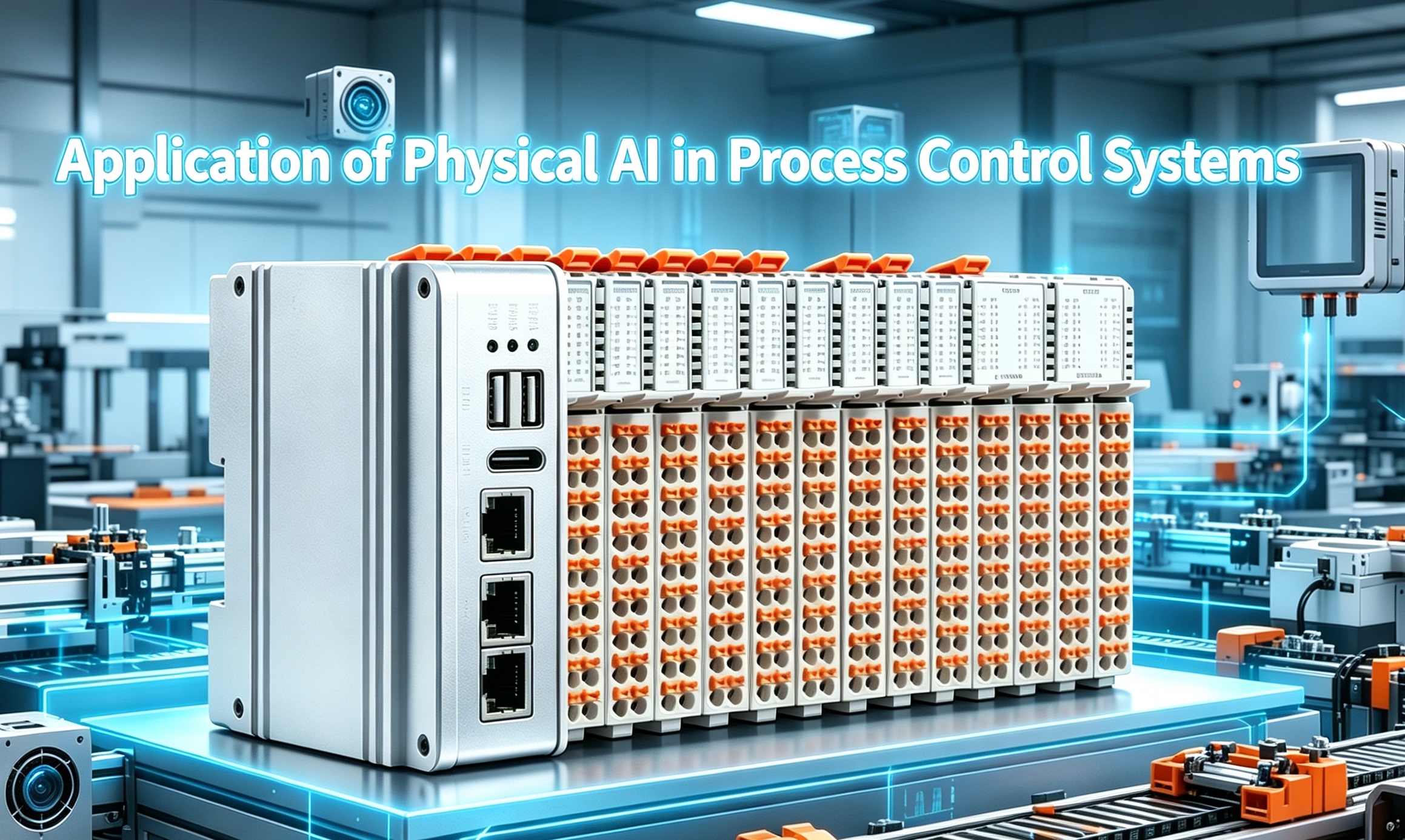
The enterprise introduced an intelligent production line optimisation solution based on the EdgePLC BL245 series industrial AI edge controller. The BL245 is not a mere combination of a PLC and an industrial PC; rather, it integrates real‑time control and edge AI computing from the bottom‑up – from chip architecture to software ecosystem. Guided by the Physical AI philosophy, it deeply integrates the IEC 61499 distributed event‑driven standard with CODESYS (IEC 61131‑3) real‑time logic control, and incorporates an embedded NPU for edge AI inference – achieving a true AI+IT+OT unified control‑compute integration and constructing a complete Physical AI closed loop.
Hardware Deployment Architecture
The EdgePLC BL245 is installed in the field control cabinet of the reaction workshop, mounted on a DIN35 rail. It connects to field smart instruments via two RS485 serial ports, and through the N‑series I/O expansion bus it can connect up to 32 distributed I/O modules, fully covering dozens of monitoring points including reactor temperature, pressure, agitator motor current, cooling water flow rate, and catalyst dosing rate – building a comprehensive Physical AI perception network.
Physical AI Workflow: Complete Closed Loop of Perception → Inference → Decision → Execution
The EdgePLC BL245 comes pre‑installed with the EdgePLC‑OS‑V1.0 operating system (based on Ubuntu 20.04), on top of which a complete Physical AI closed‑loop workflow is constructed:
Layer 1: Physical Perception & OT Real‑time Control
-
CODESYS Runtime (IEC 61131‑3): Fully compliant with the IEC 61131‑3 standard (supporting five languages: Ladder Diagram LD, Function Block Diagram FBD, Structured Text ST, Instruction List IL, and Sequential Function Chart SFC). Engineers can directly write process control programs such as reactor temperature PID regulation, feed valve sequence control, and emergency shutdown logic – forming the “basic reflex arc” of the Physical AI execution layer.
-
OpenPLC: An open‑source PLC software suitable for simple logic control and local automation, providing flexible lightweight control options.
-
IGH EtherCAT hard real‑time master: Used for high‑precision synchronous I/O and motion control, issuing control commands to actuators in milliseconds to ensure real‑time physical execution of Physical AI decisions.
Layer 2: IT‑Edge Computing & Data Fusion
-
Ubuntu 20.04 + Docker containerisation: Supports microservice architecture and multi‑language development environments (Python/C++/Node.js), allowing IT engineers to manage control logic in the same way they manage IT microservices.
-
BLIoTLink protocol conversion software: Core data acquisition and protocol conversion, supporting multiple protocols and API secondary development, enabling seamless data flow between field devices, local HMI/SCADA, cloud platforms, and IT systems.
-
Node‑RED low‑code orchestration: Visual flow design and custom nodes for rapid data pipeline construction.
-
Grafana + Prometheus: Professional time‑series data visualisation and system resource monitoring & alerting, providing transparent visibility into the operational status of Physical AI.
Layer 3: Physical AI Core – Edge Intelligent Inference & Decision
-
6 TOPS NPU edge AI inference: Utilises the built‑in NPU of the RK3588J to run LSTM time‑series prediction models deployed via TensorFlow Lite, performing real‑time predictions on key reaction process indicators (e.g., conversion rate, by‑product formation trend, heat release rate) – this is the core “thinking” step of Physical AI.
-
YOLOv5/8 + OpenCV vision stack: A complete edge AI vision stack supporting personnel safety monitoring, leak detection, equipment status recognition, and other visual perception applications – adding “vision” to Physical AI.
-
AI inference results directly drive control: The hallmark of Physical AI is “thinking means acting” – AI inference results directly trigger control actions through CODESYS or IEC 61499 function block networks, without intermediate forwarding, achieving millisecond‑level closed loop from AI perception to physical execution.
Layer 4: Deep OT‑IT Integration – IEC 61499 Distributed Collaboration
IEC 61499 is an international standard for distributed industrial control systems issued by the IEC. Unlike the cyclic scan model of traditional IEC 61131‑3, IEC 61499 adopts an event‑driven, function‑block network architecture, and is a key technical enabler for building distributed collaborative control in Physical AI:
-
Faster event‑driven response: Control logic is triggered by events rather than fixed‑cycle scans, which is particularly suitable for safety interlocking, emergency shutdown, and other scenarios in the chemical industry that require millisecond responses – ensuring the “fast action” capability of Physical AI.
-
Function blocks can be deployed distributively: Function blocks can be distributed across multiple controllers, supporting hot‑swap, online modification, and cross‑device coordination. Multiple EdgePLC units can form a logical “large controller” through a function block network, enabling collaborative control across devices.
-
Decoupling of control logic from hardware: Based on the IEC 61499 standard, control logic can be freely migrated between industrial PCs and edge gateways, allowing engineers to manage control logic like IT microservices, significantly improving engineering efficiency and system maintainability.
In practical Physical AI applications, CODESYS and IEC 61499 each play their role and work together:
-
CODESYS (IEC 61131‑3) handles real‑time logic control for individual devices – e.g., reactor temperature PID regulation, valve sequence control – deterministic periodic tasks that constitute the “basic motion” capability of Physical AI.
-
IEC 61499 handles distributed collaboration and event‑driven control across multiple devices – e.g., multi‑reactor coordinated scheduling, flexible batch production reconfiguration, safety interlock broadcasting – the “coordinated action” capability of Physical AI.
-
AI inference results trigger control actions through the event mechanism of IEC 61499, completing the full “perceive → think → act” closed loop of Physical AI.
4. Application Results
After the system went live, significant improvements were achieved:
During one batch reaction, the Physical AI model predicted a decrease in catalyst activity 45 minutes in advance, which would have slowed the reaction rate. The system automatically triggered coordinated control via the IEC 61499 event‑driven mechanism – fine‑tuning the catalyst dosing rate, adjusting the reactor jacket temperature, and simultaneously notifying adjacent workstations – successfully avoiding a whole batch downgrade. This is a typical embodiment of the Physical AI “perceive‑think‑act” closed loop in an industrial setting.
5. Core Value Summary: Physical AI-Driven Deep Integration of AI+IT+OT
The Physical AI process control solution based on the EdgePLC BL245 achieves a complete “perception → inference → decision → execution” closed loop and deep integration of the AI, IT, and OT domains:
-
Physical Perception (OT layer): N‑series I/O modules collect physical process parameters such as temperature, pressure, and flow rate – the “sensory system” of Physical AI; CODESYS (IEC 61131‑3) and OpenPLC provide real‑time logic control – the “basic motion system” of Physical AI.
-
Data Fusion & Computing (IT layer): Ubuntu 20.04 + Docker + Node‑RED + Python/C++ enable edge computing, data processing, and microservice architecture; BLIoTLink achieves multi‑protocol data fusion and IT/OT data convergence.
-
Intelligent Decision‑making (AI layer): 6 TOPS NPU + TensorFlow Lite / PyTorch Mobile + YOLOv5/8 deliver edge AI inference and vision intelligence – the “brain” and “vision system” of Physical AI.
-
Closed‑loop Execution (Integration layer): IEC 61499 distributed event‑driven standard decouples control logic from hardware, enables cross‑device collaboration, and facilitates AI‑event‑driven distributed control – allowing AI inference results to trigger physical execution actions in real time, completing the full Physical AI loop from perception to decision to action.
The BL245 seamlessly merges real‑time PLC control (IEC 61131‑3 programming environment + IGH EtherCAT master) with 6 TOPS of edge AI compute power, breaking the traditional architecture barrier where “PLCs only control and servers only compute” – this is the core implementation of the Physical AI concept: enabling devices not only to “execute”, but also to “perceive, think, and act”, achieving the unified paradigm of “control is intelligence, and intelligence is control”.
As the process industry transitions from automation to the “cognitive manufacturing” paradigm, the EdgePLC BL245 industrial AI edge controller provides a full‑chain Physical AI implementation path – from physical perception to intelligent decision‑making to precise execution – for chemicals, pharmaceuticals, oil & gas, metallurgy, and other industries, helping enterprises build smarter, more efficient, and safer next‑generation process control systems.


