The EdgePLC BL245 Series Industrial Edge AI Controller is deeply integrates real-time control, edge computing, AI inference, and open connectivity – redefining what is possible in process control.
Case Details
Why EdgePLC Industrial Edge AI Controller is the Best Choice for Process Control?
In process industries (such as chemical, pharmaceutical, oil & gas, food & beverage) and critical process segments of discrete manufacturing, “process control” is facing a profound transformation. While traditional DCS and PLC systems have proven their stability, their inherent limitations are increasingly becoming bottlenecks to production efficiency in today’s data-driven and intelligent decision-making era.
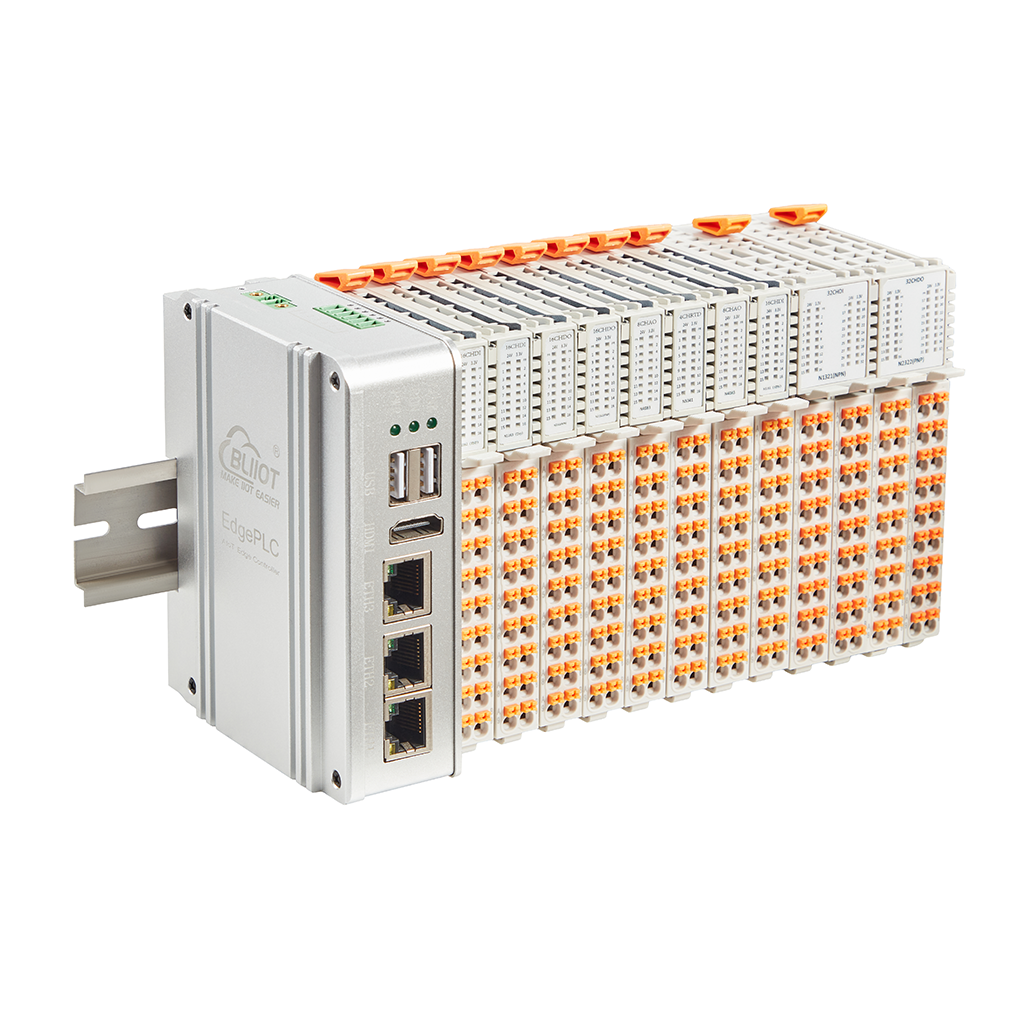
The EdgePLC BL245 Series Industrial Edge AI Controller is purpose-built to solve these challenges. It deeply integrates real-time control, edge computing, AI inference, and open connectivity – redefining what is possible in process control.
I. Three Core Pain Points in Current Process Control
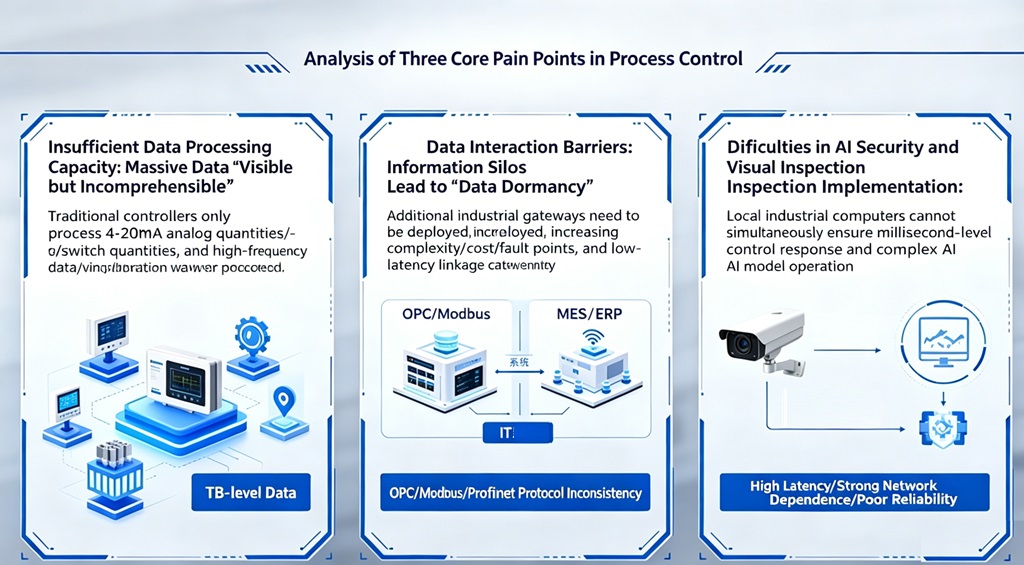
1. Insufficient Data Processing Capacity: “Can see but cannot process” massive data
Modern process control generates terabytes of data from sensors, smart instruments, vibration monitors, etc. Traditional controllers can only handle simple analog (4-20mA) and discrete signals. For high-frequency data, vibration waveforms, high‑resolution images, and other complex information, they are forced to either “discard” or “upload” the data. Real‑time on‑site analysis, feature extraction, and anomaly detection are impossible, leaving vast amounts of valuable process information untapped.
2. Data Interaction Barriers: “Data silos” keep information asleep
A long‑standing gap exists between process control systems (OT) and upper‑level IT systems (MES, ERP). Protocols such as OPC, Modbus, and Profinet each work in isolation; data formats are incompatible. To enable data exchange, an extra industrial gateway is often required, which increases system complexity, cost, and points of failure. Worse, this “controller + gateway” separation cannot deliver low‑latency control‑level data interaction.
3. AI Safety & Vision Inspection Difficult to Deploy: Trade‑off between computing power and real‑time performance
Process control demands extremely high safety. AI vision inspection (e.g., material leak detection, flame detection, personnel intrusion) and AI safety monitoring (e.g., predictive maintenance, abnormal process warnings) have become essential. However, traditional solutions usually follow the path: “camera capture → upload to cloud or industrial PC for analysis → send commands back”. This results in high latency, network dependence, and poor reliability. Even with a local industrial PC, it is difficult to run complex AI models while maintaining millisecond‑level control response.
II. EdgePLC BL245: The “Control + Compute” Platform Born for Process Control
EdgePLC BL245 is not a simple upgrade of traditional PLCs. It is an industrial edge AI controller that fundamentally merges real‑time control with intelligent computing. With the following core capabilities, it is the best solution to the pain points above.
1. Powerful On‑Site Data Processing & AI Inference: No more “data upload anxiety”
-
Heterogeneous computing architecture – Based on Rockchip RK3588J processor, integrating 4x Cortex‑A76 + 4x Cortex‑A55 + 3x Cortex‑M0 cores, plus an onboard 6 TOPS NPU. This allows it to handle simultaneously:
-
A76 cores: Run Linux OS, AI models, and complex algorithms.
-
A55 cores: Manage communication protocol stacks and data aggregation.
-
M0 cores: Guarantee millisecond‑level real‑time I/O response and EtherCAT synchronization.
-
Local AI vision stack – Pre‑integrated YOLOv5/8 + OpenCV, enabling image acquisition, preprocessing, object detection, and result output directly on the controller. For example, it can directly connect USB or network cameras to monitor reactor liquid levels, pipeline leaks, or personnel PPE compliance – all processed locally with latency below 50ms, completely independent of cloud computing.
2. Native Support for IEC 61499: True Event‑Driven Distributed Process Control
This is one of the biggest differences between EdgePLC and traditional PLCs. Traditional PLCs are based on IEC 61131‑3 cyclic scanning, whereas process control demands fast, event‑driven responses.
-
IEC 61499 standard – EdgePLC supports distributed control systems based on IEC 61499. This standard uses “function blocks” and “events” as core elements, allowing control logic to be distributed across multiple controllers and triggered via network events.
-
Revolutionary significance for process control:
-
Decoupling & reuse – A process unit (e.g., a distillation column or reactor) can be encapsulated as an independent IEC 61499 function block application, easily reused across the plant, dramatically reducing engineering complexity for large projects.
-
True distribution – When an event is triggered by a process parameter (e.g., temperature exceeds limit), the event propagates instantly to neighboring controllers, enabling millisecond‑level coordinated actions across equipment – without waiting for the next scan cycle of a central PLC.
-
Agile reconfiguration – For batch processes, IEC 61499 applications can be dynamically reconfigured, greatly improving flexible production capability.
3. Deep CODESYS Integration: A Professional Control Platform that Bridges Legacy and Future
EdgePLC provides a CODESYS Runtime (Pro version), widely recognized as a powerful development environment in process control.
-
Full IEC 61131‑3 support – Compatible with LD, FBD, ST, IL, and SFC, enabling smooth migration for traditional PLC engineers.
-
Advanced motion control & CNC – Options support SM (basic motion control) and CR (CNC+Robotics), meaning EdgePLC can also handle servo valve banks, multi‑axis robots, or complex trajectories if needed.
-
Seamless integration of AI and IT – Built‑in CODESYS features like WebVisu and Data Server easily push process variables to SCADA or MES. More importantly, CODESYS programs can directly call underlying Linux C++/Python libraries, enabling a closed loop where “control logic invokes AI model outputs”.
4. All‑in‑One Versatility: Breaking Data Silos and Simplifying System Architecture
EdgePLC itself is a “super gateway”:
-
Protocol conversion & data aggregation – Onboard BLIoTLink core software supports numerous industrial protocol conversions. It can directly act as a Modbus TCP/RTU master, OPC UA server, or MQTT client, unifying data collection and standardization from instruments, drives, and analyzers of different brands.
-
Remote operation & maintenance – Equipped with BLRAT secure remote access channel, enabling engineers to perform remote debugging, program upload/download, and log analysis without additional VPN or remote gateway hardware.
-
Visualization & alarming – Built‑in FUXA (lightweight SCADA) and Grafana (professional dashboard). It can directly connect to a display via HDMI for local monitoring, or publish web‑based remote views.
5. True Industrial Reliability – Designed for Harsh Process Environments
Process control demands 7×24 uninterrupted operation. EdgePLC BL245 series has passed rigorous validation:
-
Wide operating temperature – Industrial‑grade SOM options support ‑40°C to +85°C, stable in both severe cold and hot, humid plant environments.
-
High electromagnetic compatibility – Passed GB/T 17626 series Level III tests (ESD contact ±6kV, EFT power 2kV, surge common mode 4kV), reliable even near strong interference sources like VFDs and large motors.
-
Hardware watchdog & protection – Independent hardware watchdog ensures automatic reset on system anomalies; supports wide voltage 12‑24VDC input with reverse polarity and overcurrent protection.
Conclusion: Why EdgePLC is the Future of Process Control
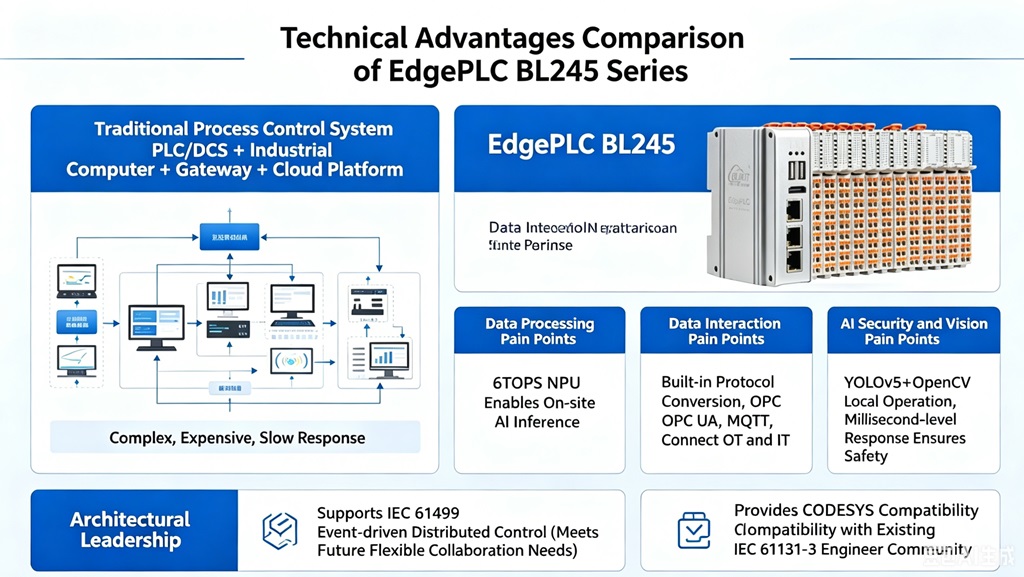
The traditional process control system architecture – “PLC/DCS + industrial PC + gateway + cloud platform” – is complex, expensive, and slow to respond. EdgePLC BL245 consolidates all of the above capabilities into a single DIN‑rail device the size of a palm.
-
It solves the data processing pain point – 6 TOPS NPU makes on‑site AI inference a standard feature.
-
It solves the data interaction pain point – Built‑in protocol conversion, OPC UA, MQTT bridges OT and IT.
-
It solves the AI safety & vision pain point – YOLOv5+OpenCV runs locally with millisecond response, protecting personnel and process safety.
-
Its architecture is future‑ready – Supports IEC 61499 event‑driven distributed control to meet the needs of future flexible, collaborative process control; at the same time, CODESYS addresses the existing large base of IEC 61131‑3 engineers.
For process industry enterprises that want to bring AI capability down to the production edge, break data silos, and maintain real‑time control reliability – the EdgePLC BL245 is the most balanced, forward‑looking, and cost‑effective choice available today. It is not just a replacement for PLCs; it redefines the standard for next‑generation process controllers.


