EdgeIO Controller Smart Pig Farm Solution – Precisely Connecting Sensors, Feed Lines, and Fans, Bridging IT Monitoring Dashboards with OT Field Data for Real-Time Monitoring, Environmental Control, and Intelligent Alarming
EdgeIO Controller Smart Pig Farm Solution – Precisely Connecting Sensors, Feed Lines, and Fans, Bridging IT Monitoring Dashboards with OT Field Data for Real-Time Monitoring, Environmental Control, and Intelligent Alarming
I. Industry Pain Points: Device Isolation and Data Disconnects Hinder Smart Pig Farm Adoption
As pig farm digital transformation enters a deeper phase, the industry faces the following critical bottlenecks:
-
Diverse and incompatible field devices – Temperature/humidity sensors, ammonia detectors, variable-frequency fans, automatic feed lines, water-curtain pumps, and other equipment come from different manufacturers with varying interfaces (4–20mA, 0–10V, pulse, RS485/Modbus, etc.), making connection difficult and commissioning time‑consuming.
-
OT data cannot reach IT systems – Environmental control and feeding systems operate independently, with data stored only in local PLCs or HMIs. They cannot be provided in standardized formats (e.g., OPC UA) to central dashboards, ERP, MES, or other IT systems, so managers cannot view real‑time status across all barns from the office.
-
Slow alarm response – Traditional alarms rely on local audible/visual signals or manual inspections. In case of fan failure, excessive ammonia, or temperature anomalies, relevant personnel are not notified promptly, leading to pig stress, higher feed‑conversion ratios, or even increased mortality.
-
Poor remote maintenance visibility – Pig farms are often remote; when equipment fails, technicians must travel on‑site, delaying recovery and increasing maintenance costs. Remote firmware upgrades or parameter adjustments are also not supported.
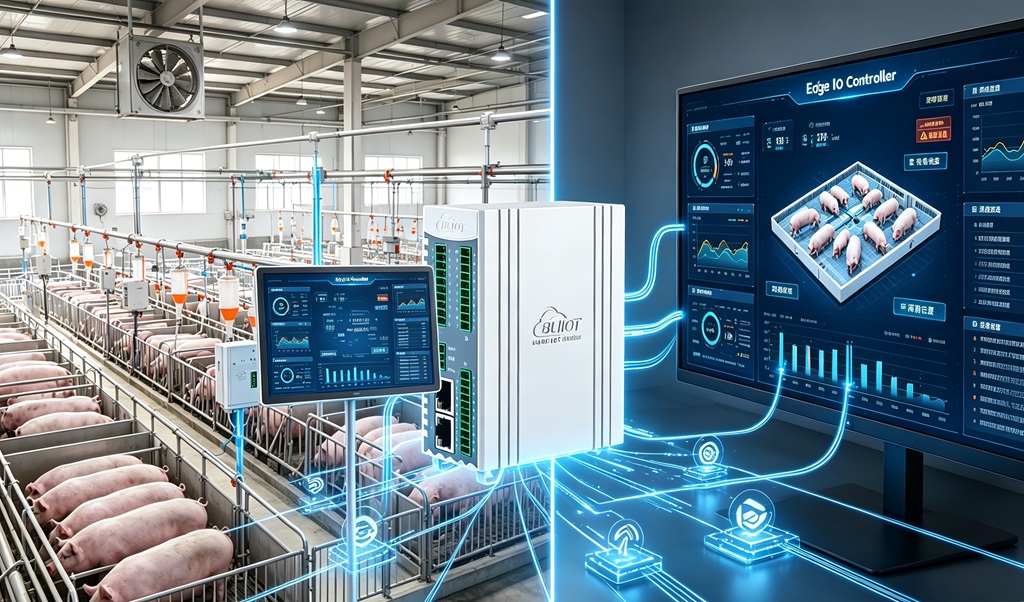
II. Solution: Using the EdgeIO Controller BL192Pro as the "Data Hub"
Bliiot’s EdgeIO Controller BL192Pro integrates I/O acquisition, logic control, protocol conversion, and cloud‑edge collaboration into a single device, specifically designed for complex farm equipment environments. Its core value is “connecting all field devices and seamlessly interfacing with IT dashboards.”
2.1 Field Device Connection: Comprehensive Coverage for Sensors, Feed Lines, and Fans
The BL192Pro features a modular I/O design (base unit + up to 3 Y‑series expansion modules) supporting over 20 I/O types, perfectly matching various pig farm equipment:
In practice, one BL192Pro can cover a standard pig barn (about 20–30 measurement/control points) and implement closed‑loop autonomous control through local logic (edge computing). For example, when ammonia ≥10 ppm, the controller immediately activates fans to ventilate – all without relying on the cloud, ensuring reliable environmental control even during network outages.
2.2 Deep Integration of IT Monitoring Dashboards and OT Field Data
The BL192Pro comes with a built‑in OPC UA server and MQTT client, for the first time opening OT field data to IT layers via standardized industrial interfaces, thoroughly breaking data silos:
Result: Managers can view at a glance on the office dashboard – real‑time temperature trends in each barn, fan operating frequencies, feeding progress, and alarm lists – with historical data retrieval and trend forecasting. The integration of IT and OT data automatically generates environment‑production performance reports to support informed decision‑making.
2.3 Real‑Time Monitoring, Equipment Status, and Intelligent Alarm Business Closed‑Loop
Based on the BL192Pro’s edge computing capability and cloud collaboration, we build a complete “Acquisition‑Analysis‑Alert‑Action” loop:
-
Real‑time monitoring – All analog and digital signals are scanned at millisecond intervals and reported via MQTT in real time (upload intervals configurable), with dashboard data refresh latency <1 second.
-
Equipment health monitoring – Beyond sensor values, the controller also monitors equipment health (e.g., fan running current, inverter fault codes, feeder motor overload signals), enabling full lifecycle management.
-
Intelligent alarming:
-
Local pre‑judgment – Thresholds set within the controller (e.g., temperature >30°C, ammonia >8 ppm, fan stoppage) trigger local audible/visual alarms via relay outputs.
-
Remote push – Simultaneously, alarm events are sent via MQTT to the cloud, which then sends notifications via SMS, mobile APP, or WeChat Work to ensure that farm managers and veterinarians are informed immediately.
-
Graded alarms – Different severity levels (critical: ammonia exceedance; moderate: temperature deviation; reminder: low feed bin) correspond to distinct handling workflows.
-
Remote maintenance – With the built‑in BLRAT tool, O&M personnel can remotely log in to view real‑time data, modify control parameters, and upgrade firmware without being on‑site, reducing Mean Time To Repair (MTTR) from hours to tens of minutes.
III. Core Advantages of the Solution
-
All‑in‑one simplification – Replaces the traditional “PLC + gateway + converter” stack, lowering procurement costs by over 40% and reducing failure points.
-
Full protocol interoperability and true IT/OT convergence – Native OPC UA and MQTT support eliminates custom development; plug‑and‑play connection to monitoring dashboards and enterprise systems.
-
Edge intelligence, offline‑safe – Local control logic runs independently; network interruption does not affect environmental control loops, ensuring livestock safety.
-
Flexible scalability for any farm size – Modular I/O allows tailored configuration from small family farms to large‑scale operations.
-
Industrial‑grade reliability – Wide temperature range (-45°C to 80°C), anti‑interference, hardware watchdog – suitable for the humid, dusty environment of pig farms.
-
Remote maintenance reduces cost – Remote debugging, upgrades, and diagnostics significantly cut travel expenses – especially beneficial for group operations managing multiple farms.
IV. Successful Case in Denmark: 500‑Unit Verified Large‑Scale Deployment
A large Danish pig‑farming group, with dozens of farms, previously faced challenges such as mixed brands of equipment, inability of the control centre to obtain real‑time data, and delayed alarms. Since 2023, the group has successively deployed over 500 sets of BL192Pro controllers across all pig barns:
-
Connected equipment – Each controller connects temperature/humidity and ammonia sensors, automatic feed lines, and VFD fans plus water‑curtain systems.
-
IT/OT integration – Via OPC UA, all field data are aggregated to the group’s central monitoring dashboard at headquarters, while also interfacing with the farming ERP to correlate environmental data with production performance (feed intake, daily gain, mortality).
-
Alarm effectiveness – After system go‑live, abnormal event response time dropped from an average of 45 minutes to under 3 minutes, and losses caused by environmental failures decreased by 70%.
-
Maintenance savings – Remote maintenance reduced on‑site visits by 80%, saving over €1 million annually in travel and labour costs.
This case proves that Bliiot’s EdgeIO Controller not only connects various field devices but also perfectly achieves IT/OT data integration and real‑time monitoring/alarming, making it a trustworthy choice for digital pig farm upgrades.
V. Conclusion
Bliiot’s EdgeIO Controller BL192Pro, built around “Connect, Converge, and Intelligently Act,” provides pig farms with a full digital infrastructure from sensors, feed lines, and fans to monitoring dashboards and cloud platforms. Whether you are building a new smart pig farm or retrofitting existing traditional facilities, this solution enables you to stay in real‑time control of the environment and equipment, respond rapidly to anomalies, and truly let data drive production efficiency.


