Small PLCs are products of the Industrial Automation 1.0 era – built for “control,” yet constrained by “data flow.” The EdgeIO Controller, by contrast, is a native architecture for the Industrial IoT era
EdgeIO Controller vs. Small PLC: A Paradigm Shift in Industrial Control Architecture
In the era of rapid convergence between industrial automation and the Industrial Internet of Things (IIoT), traditional small PLCs (Programmable Logic Controllers) have long played the core role of standalone machine control. However, as data needs to go to the cloud, systems must interconnect, and devices require remote maintenance, the limitations of small PLCs have become increasingly evident. Bliiot’s EdgeIO Controller, with its “all‑in‑one device replacing PLC + I/O + gateway” architecture, is redefining the boundaries of industrial edge control.
I. The Three Inherent Shortcomings of Small PLCs
Shortcoming 1: Closed Architecture – Data Cannot Get Out
Small PLCs are essentially designed for “control” – they excel at executing ladder logic, starting/stopping motors, counting and timing. However, they were never built for “data flow” from the ground up. Their closed architecture, proprietary programming software, and private communication protocols make it difficult to expose field data to higher‑level IT systems in a standardised manner. When enterprises need to connect production line data to MES, ERP, or cloud platforms, small PLCs often fall short and require additional protocol converters – which means new hardware costs, new configuration efforts, and new points of failure.
Shortcoming 2: Single Protocol – Difficult Interconnection
Typical small PLCs only support limited onboard communication interfaces and have relatively limited communication capabilities. If multiple brands of sensors, VFDs, or instruments are present on site, small PLCs often require additional communication modules or paid protocol stacks to interface with them. This not only drives up costs but also makes system integration exceptionally complex. In the IIoT era, devices need to simultaneously communicate with HMIs, SCADA, cloud platforms, MES, and other systems – a single‑protocol PLC is clearly out of its depth.
Shortcoming 3: Remote Maintenance – Virtually Nonexistent
Programming, parameter tuning, and debugging for small PLCs rely almost entirely on local connections – engineers must travel on‑site, connect the programming cable, and open proprietary software to perform any operation. For equipment deployed in remote locations (e.g., pumping stations, farms, distributed sites), this “only‑on‑site” maintenance mode means high travel costs, prolonged downtime, and poor responsiveness.
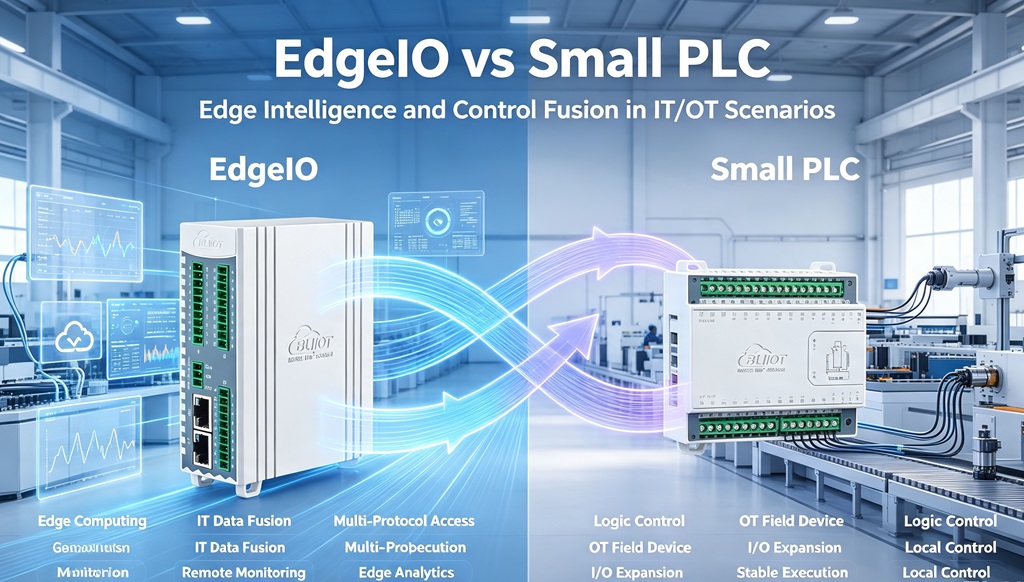
II. EdgeIO Controller: A New‑Generation Edge Intelligence Node Born for Data Flow
Bliiot’s EdgeIO Controller BL192Pro is a multi‑protocol edge I/O controller designed for industrial IoT and smart manufacturing. It integrates data acquisition, logic control, protocol conversion, and remote maintenance into a single device, replacing the cumbersome combination of traditional “PLC + I/O modules + protocol gateway + cloud gateway.” Below, we examine three core dimensions where EdgeIO comprehensively outperforms small PLCs.
III. Core Comparison: Why Can EdgeIO Replace Small PLCs?
Comparison 1: Modbus Slave Data Acquisition – EdgeIO “Downward Compatible,” Small PLC “Upward Restricted”
The Dilemma of Small PLCs:
When an existing HMI touchscreen communicates with the PLC via Modbus RTU, replacing that PLC often means reprogramming the HMI and remapping all addresses – a heavy workload that may even necessitate replacing the entire HMI. Engineers must face the predicament of “change one, break everything.”
EdgeIO’s Breakthrough:
The EdgeIO BL192Pro supports Modbus RTU slave mode and can precisely emulate the original PLC’s Modbus address mapping. This means the existing HMI requires no modifications whatsoever – it can continue reading DI states, writing DO commands, and everything else as before. Meanwhile, the BL192Pro also supports Modbus RTU master mode, enabling it to simultaneously collect data from multiple slave devices (up to 25 instructions) via its isolated RS485 port.
In a nutshell: A small PLC can only “be collected” (act as a slave), while EdgeIO can both “be collected” (as a slave to interface with existing HMI) and “actively collect” (as a master to read third‑party devices) – one device, dual roles, performing both downward compatibility and upward data acquisition flawlessly.
Comparison 2: Multi‑Protocol Support – EdgeIO “Speaks All,” Small PLC “Speaks One”
The Dilemma of Small PLCs:
Traditional small PLCs typically support only a single or very few protocols (e.g., Modbus RTU). To connect to cloud platforms, a separate MQTT gateway is required; to interface with MES/ERP, an OPC UA gateway is needed. The more devices stacked, the bulkier the system and the more failure points arise.
EdgeIO’s Breakthrough:
The EdgeIO BL192Pro natively integrates Modbus RTU/TCP, MQTT, and OPC UA – three major industrial protocols:
One BL192Pro simultaneously opens data channels across field device layer, local HMI layer, cloud platform layer, and enterprise IT layer. To achieve the same with a small PLC, you would need at least four separate devices: “PLC + Modbus gateway + MQTT gateway + OPC UA gateway.”
In a nutshell: A small PLC is a “monolingual” device; EdgeIO is a “simultaneous interpreter of four languages” – one device handles acquisition, conversion, cloud upload, and IT‑level exposure all at once.
Comparison 3: Remote Configuration and Maintenance – EdgeIO “Thousands of Miles Away,” Small PLC “Must Be On‑Site”
The Dilemma of Small PLCs:
Programming and debugging for small PLCs are heavily dependent on local connections – engineers must travel with programming cables and laptops to the site, plug into the CPU, and only then can they modify parameters, upgrade firmware, or troubleshoot. For equipment spread across remote locations or overseas projects, this model is nearly unacceptable.
EdgeIO’s Breakthrough:
The EdgeIO controller comes with a built‑in BLRAT remote access tool, supporting full remote maintenance operations including parameter modification, firmware upgrades, and fault diagnosis. Engineers no longer need to visit sites – they can accomplish:
-
Remote configuration: Via a web browser, complete logic programming such as register calculations and conditional judgments – no specialised software installation required.
-
Remote upgrades: Push firmware updates remotely and perform batch upgrades.
-
Remote diagnostics: View real‑time device status and troubleshoot issues from afar.
Additionally, EdgeIO features a dual‑port switch built‑in, supporting daisy‑chain topology for cascading, eliminating the need for external switches and simplifying network cabling.
In a nutshell: Small PLC maintenance is “people looking for devices”; EdgeIO maintenance is “devices looking for people” – everything can be done remotely, driving travel costs toward zero.
IV. Comparison Summary
V. Conclusion
Small PLCs are products of the Industrial Automation 1.0 era – built for “control,” yet constrained by “data flow.” The EdgeIO Controller, by contrast, is a native architecture for the Industrial IoT era – born and designed for “connectivity”: downward compatibility via Modbus slave for smooth legacy system migration; horizontal multi‑protocol support for free data flow among devices, HMIs, clouds, and IT systems; and upward remote maintenance for engineers to control everything from thousands of miles away.
When your project satisfies any two of the following conditions, the value of EdgeIO has already far exceeded the traditional “PLC + I/O + gateway” approach:
-
✅ Data needs to go to the cloud or connect with cloud platforms
-
✅ Local logic control / interlocked alarming is required, but you don’t want the complexity of a PLC
-
✅ Signal types are diverse and require mixed I/O acquisition
-
✅ Equipment is located remotely, making remote maintenance a must‑have
From the stacked architecture of “PLC + gateways” to the integrated architecture of “one EdgeIO covers the entire site” – this is not just an improvement, but a paradigm shift in industrial control.
(For detailed technical specifications or live demonstrations, please contact the Bliiot sales team.)


